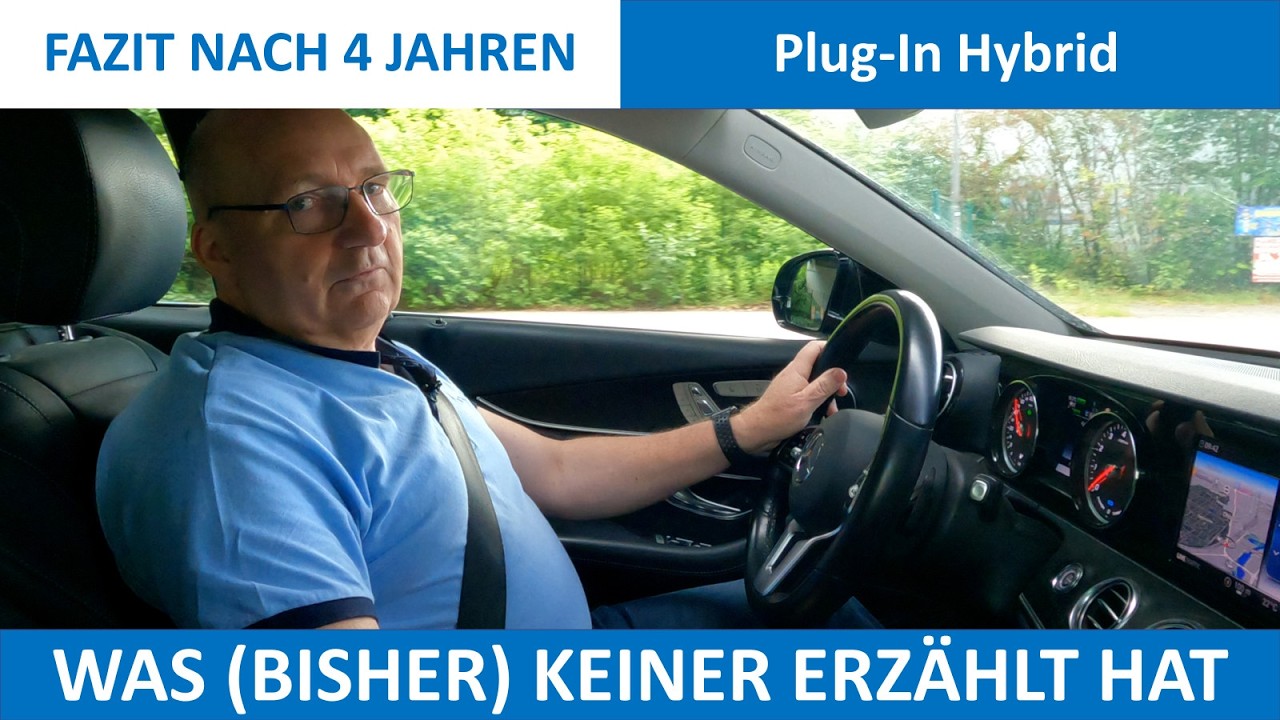
Conclusion after 4 years of plug-in hybrid driving – What nobody told you
Yes, hello, dear people of the internet. Today the accountant is once again sitting in the car and talking about his experiences with the plug-in hybrid, a Mercedes E 300 E. Back then, I deliberately chose not to go with a diesel and opted for a gasoline engine instead. The price difference was not that significant, and I thought I wouldn’t be driving many kilometers on gasoline. But things turned out differently.
In the first year, when I had leased the car, we lived just 2.5 kilometers from the office. We had our own parking space, but no charging option. Public charging stations were my lifeline. Again and again, I charged the car at work. For longer trips, I used the gasoline engine.
But then my everyday life changed.
The move to a semi-detached half
Three years ago, we moved into a semi-detached house on the outskirts of town. Now I drive 15 kilometers to the office every day and back again after work. Public transport is not an option here. I often take my wife and children with me and drop them off along the way.
The good news: I can drive this route almost entirely on electric power now that I have a wallbox in the carport. In summer, the range is about 35 kilometers, and in winter 25 kilometers.
Moving into the semi-detached house was not just a change of address, but also a decisive change in my everyday life. The new living situation brought the advantage of having my own charging option. Installing the wallbox was straightforward, and it has made my daily routine much easier.
Being able to charge my vehicle overnight and set off the next morning with a full battery is a convenience I would not want to do without. Especially in summer, when the range increases thanks to the battery’s higher efficiency, I enjoy being independent of gas stations.
The reality of a plug-in hybrid
Of course, the range is nowhere near the 50 kilometers promised in the brochure. Even so, I drive electrically about 75% of the time. At 73.
000 kilometers of total distance, that is impressive. But there is also a downside: when I need a lot of power, the combustion engine kicks in. That is especially the case during overtaking maneuvers or quick acceleration. The engine then is pushed to full load while stone cold, which always makes me feel somewhat uneasy.
The decision to drive a plug-in hybrid was motivated by the desire to get around in a more environmentally friendly way.
However, reality has shown that not everything that glitters is gold. While electric driving is ideal in city traffic and the noise level is pleasantly reduced, a different picture emerges on longer trips and during acceleration. The combustion engine, which switches on when more power is required, abruptly puts an end to the comfort of quiet driving. It is especially unpleasant when the engine is cold and still running under full load. These moments repeatedly leave me with a feeling of unease, both from a technical perspective and in terms of environmental impact.
The Sport mode trick
To spare the combustion engine, I switch to sport mode in such situations. That way, the engine is already warmed up beforehand. When overtaking, I do not floor it so as to avoid activating the combustion engine as much as possible. The car is extremely quiet and comfortable. But the cold four-cylinder is quite loud in city traffic, which gives me a bad feeling every time.
The Sport mode is a little trick I picked up over time to minimize engine wear. It may seem paradoxical to use Sport mode to be easy on the engine, but it works. It activates the engine earlier and brings it up to operating temperature more quickly. That way, at least I can avoid the feeling of running the engine at full load when it is ice cold. However, the noise of the cold engine in city traffic remains a nuisance that detracts from an otherwise very pleasant driving experience.
Plug-in hybrid: A concept with pros and cons
The plug-in hybrid concept has its advantages. Driving electrically 75% of the time is impressive. On longer trips or on vacation, I can switch to gasoline. The trunk is large enough despite the battery. There were hardly any problems: once a screw in the tire and a marten that bit through a cable.
Mercedes' service, however, was exemplary.
A plug-in hybrid combines the best of both worlds: the electric efficiency for daily commuting and the range of a gasoline car for longer journeys. This flexibility was one of the main reasons I chose this vehicle. But as with any technology, there are downsides here too. The limited electric range, the noise from the combustion engine when cold, and the occasional technical problems, which were rare but still occurred, are aspects that should be considered when deciding on a plug-in hybrid.
Even so, I have to praise Mercedes' service, which was there quickly and competently in every situation.
Farewell and a new beginning
After four years, it is time to switch to a fully electric vehicle. I am looking forward to getting by without gasoline. My own wallbox makes charging much easier. With a bit of sadness, I will be parting with my plug-in hybrid, but progress is calling.
Mercedes' service and quality convinced me, so my next car will come from there again.
Parting with my plug-in hybrid is not easy for me, because despite the challenges mentioned, I have had many positive experiences. The decision to switch to a fully electric vehicle is a step toward the future, one I look forward to with joy and excitement. The advantages of a pure electric vehicle, such as zero emissions while driving, speak for themselves. Thanks to the wallbox, I can also make sure my vehicle is always ready in the future.
My trust in Mercedes' quality and service has solidified over the past few years, which is why I am choosing this brand again. The progress in electric mobility is exciting, and I am curious about the experiences my new vehicle will bring.
So, dear people, that is it from the accountant's perspective on his vehicle. Have a nice day. Bye.

Comments are no longer available